


Table of Contents
- Quick Comparison: Best Durable Toys for Aggressive Chewers
- How to Choose Dog Toys for Aggressive Chewers
- Durable Rubber Dog Toys That Withstand Strong Jaws
- Safe Chew Toys for Power Chewers: Nylon and Rubber Trade-Offs
- Top Picks: Best Dog Toys for Aggressive Chewers Reviewed
- Matching Toys to Dog Size, Jaw Strength, and Chewing Style
- Safety, Inspection, and When to Replace a Chew Toy
- Conclusion
- Frequently Asked Questions
Last Updated: October 20, 2026
Quick Comparison: Best Durable Toys for Aggressive Chewers
Finding durable toys for aggressive chewers starts with one honest admission: no toy is truly indestructible. Match material, shape, and size to your dog's jaw strength, then inspect regularly. This ShopEasyPets guide covers the materials that hold up, the rubber-versus-nylon trade-offs, and our picks.
A common mistake is buying the thickest toy on the shelf. Thickness alone does not resist tearing; tear strength does. A rubber compound with a tear-strength additive, or a solid nylon core, outlasts a soft rubber ball twice its size.
Here is the quick version before the detail:
| Toy | Price | Material | Best For |
|---|---|---|---|
| Power Stick™ | $19.99 | Industrial-strength rubber | Large breeds, intense chewers |
| USA-K9 Magnum Skull | $17.99 | Black Magnum rubber | Extreme chewers, working dogs |
| USA-K9 Magnum Grenade | $15.99 | Black Magnum rubber | Tug and fetch with high-drive dogs |
| Magnum Can Toy | $14.99 | Natural rubber | Moderate chewers, treat dispensing |
| Hurley | $12.95 | Tough floatable material | Fetch and chew, water play |
| Tux | $19.95 | Tough rubber | Short-snouted breeds, treat toys |
| Qwizl | $21.95 | Tough rubber | Making bully sticks last longer |
| Tough Bone Nylon | $10.99 | FDA-compliant nylon | Budget-friendly power chewing |
| Bone eChew | $12.99 | FDA-compliant nylon | Dogs 15-80 lbs who destroy rubber |
| Industrial Dog Ball | $15.99 | Natural rubber | Fetch for dogs 30-65 lbs |
How to Choose Dog Toys for Aggressive Chewers
Choosing toys for aggressive chewers comes down to three questions: how hard does your dog bite, what material resists that bite, and what size prevents choking.

Start with jaw strength, not breed: a determined 40-pound dog can out-chew a lazy 90-pound one.
Material matters more than marketing. Natural rubber flexes and absorbs force, gentler on teeth; nylon is harder and lasts longer but offers less give. Many owners keep both and rotate them.
Size is a safety issue, not a preference. A toy small enough to swallow is a choking risk no matter how tough it is.
Durable Rubber Dog Toys That Withstand Strong Jaws
Durable rubber dog toys work because the material flexes under pressure instead of cracking.
The USA-K9 Magnum Skull ($17.99) is our pick for extreme chewers. Its Black Magnum compound uses a tear-strength additive and is FDA-compliant and non-toxic.
The Magnum Grenade ($15.99) uses the same compound in a compact shape with a textured grip for tug-of-war.
For fetching, the Industrial Dog Ball ($15.99) is a 3-inch natural rubber ball for dogs 30-65 lbs.
Where rubber falls short: a dog that chews in one spot for hours will eventually wear through any rubber surface. Rotate toys and retire them at the first deep gouge.
Safe Chew Toys for Power Chewers: Nylon and Rubber Trade-Offs
Safe chew toys for power chewers balance durability against dental risk. Nylon lasts longer but is harder; rubber is gentler but wears faster.
Nylon shines for methodical gnawers. The Tough Bone Nylon Chew Bone ($10.99) is FDA-compliant, BPA-free, and shaped for multiple chewing angles.
Rubber suits dogs that like give and bounce. The Hurley ($12.95) is a floatable, bouncy bone that will not splinter into sharp pieces.

The trade-off: nylon can chip or crack at the edges, and hard materials stress older teeth. Check nylon toys for rough edges after every session and file or discard them.
Top Picks: Best Dog Toys for Aggressive Chewers Reviewed
The best dog toys for aggressive chewers combine reinforced material, a size that fits your dog, and an engaging shape.
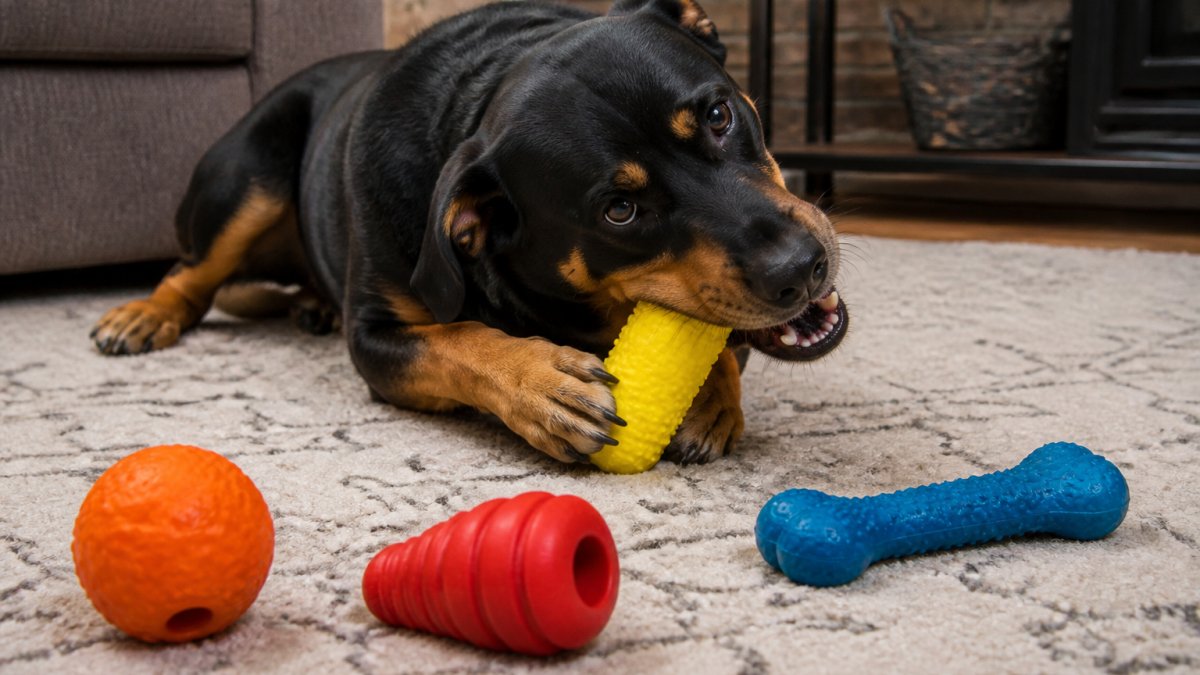
Power Stick™ ($19.99) is our overall pick for large breeds and intense chewers.
USA-K9 Magnum Skull ($17.99) is the pick for working-dog-level chewing.
USA-K9 Magnum Grenade ($15.99) suits high-drive dogs that need a tug reward during training.
Magnum Can Toy ($14.99) is the best treat dispenser of the group.
Qwizl ($21.95) is the smart choice if you buy bully sticks.

Tough Bone Nylon ($10.99) and Bone eChew ($12.99) are the budget-friendly nylon picks. Both are FDA-compliant and dishwasher safe.
Matching Toys to Dog Size, Jaw Strength, and Chewing Style
Matching a toy to your dog is a three-part check: size prevents choking, jaw strength predicts lifespan, and chewing style tells you which material survives.
Step 1: Size by weight and mouth, not by breed label. Use the stated weight range as a starting point, then size up when between two options.
Step 2: Estimate jaw strength with a simple test. You do not need a bite meter. Watch how your dog works a new toy for two or three sessions:
- Light chewer: Gnaws briefly, loses interest, leaves marks but no deformation.
- Moderate chewer: Works a toy for several minutes, creates dents and surface wear, but does not puncture.
- Power chewer: Punctures rubber, tears at seams, or removes pieces within days.
- Extreme chewer: Destroys "tough" toys in a single session or works methodically at one spot until it fails.
Step 3: Match chewing style to material. This is the variable most guides skip.
- Puncturers and tearers do best with solid nylon or reinforced rubber with no thin walls or seams.
- Methodical gnawers need nylon or dense rubber that resists wear at a single point.
- Chompers and droppers do fine with thicker rubber; they rarely concentrate force long enough to fail a toy.
- Tuggers need a toy with a handle or textured grip and reinforced attachment points; a toy that is tough to chew can still fail at a seam under tug load.
Persistent versus destructive chewing. Persistent chewing is normal drive, the dog wants to chew and will redirect to an appropriate toy.
Use this as a starting point, then adjust based on what you see:
| Dog Profile | Recommended Toy | Why |
|---|---|---|
| Large breed, destroys everything | Power Stick™ | Industrial rubber, lifetime guarantee |
| Working or high-drive dog | USA-K9 Magnum Skull | Black Magnum compound, multi-purpose |
| Dog that tears at seams | Bone eChew | Solid nylon resists tearing |
| Fast eater, moderate chewer | Magnum Can Toy | Treat dispenser and slow feeder |
| Fetch-obsessed, water lover | Hurley or Industrial Dog Ball | Floats and bounces |
| Short-snouted breed | Tux | Shallow cavity reaches treats |
| Bully stick buyer | Qwizl | Extends treat life |
Safety, Inspection, and When to Replace a Chew Toy
Supervision is the one rule that never changes. The ASPCA's pet toy safety guidance recommends removing any toy once it shows damage, and the FDA's guidance on pet product safety is a useful reference for what to look for in pet products generally.
What most guides skip is how toys actually fail. Durable toys rarely explode; they degrade in predictable ways, and knowing the failure mode tells you what to inspect for.
How durable toys fail, by material:
- Rubber: Starts with surface scuffing, then small punctures at the highest-stress point (often where the dog grips or where a treat cavity thins the wall). A puncture becomes a tear, and a tear becomes a swallowable chunk. Rubber also compresses and loses rebound over time, so an old toy that feels soft is closer to failure than a new one.
- Nylon: Develops rough edges and hairline cracks at the ends and along molded seams. Nylon does not stretch, so once a crack starts it propagates. A cracked nylon bone can splinter into sharp fragments.
- Rope and fabric: Frays into strands that can be swallowed or wrap around the tongue and teeth. Loose strands are a strangulation and obstruction risk.
- Treat-dispensing toys: The cavity rim and any moving parts wear first; small pieces can break off inside the cavity where you cannot see them.
Inspection routine after every session:
- Check for cracks, punctures, or deep gouges, run a fingernail across the surface; if it catches, the damage is structural
- Feel the edges for sharp or rough spots
- Look for pieces the dog has worked loose, especially inside treat cavities
- Confirm the toy still matches your dog's size, a toy that was correctly sized for a puppy may be a choking hazard for an adult
- Wash rubber and nylon toys as needed; residue hides cracks and encourages bacterial growth
Replace, do not repair, at these triggers:
- Any crack that goes deeper than the surface
- A puncture you can fit a fingertip into
- A chunk missing, or a piece loose enough to pull off
- Sharp or rough edges on nylon that do not smooth with light sanding
- A rubber toy that has lost its bounce or feels tacky
- Frayed rope strands longer than about an inch
A small puncture on a nylon bone can become a splinter; a deep gouge in rubber can tear into a swallowable chunk. The rule of thumb: replace at the first sign of structural damage, not the first cosmetic mark.
Cost is part of safety too. A $19.99 toy that lasts a year beats four $8 toys that fail in a month, in money and in risk. Factor replacement value into your choice, not just the sticker price, and note when each toy entered rotation so you can spot wear trends before they become hazards.
Conclusion
The hardest part of buying for a power chewer is accepting that "indestructible" is marketing, not a guarantee. Match the material to how your dog actually chews, size the toy correctly, and inspect it after every session.
At ShopEasyPets, we stock a curated range of durable toys, from the industrial-rubber Power Stick™ to FDA-compliant nylon bones, so you can find the right fit for your dog's jaw strength and chewing style. Our selection is chosen for quality and safety, and every order ships from one convenient place.
Get started with ShopEasyPets and give your power chewer a toy that keeps up.
Frequently Asked Questions
What are the most durable toys for aggressive chewers?
The toughest options combine dense natural rubber or solid nylon with a design that resists tearing. Look for toys labeled for power or extreme chewers, such as the USA-K9 Magnum line, the SodaPup Tough Bone, and the West Paw Hurley. These use materials engineered for strong jaws rather than soft plush or thin plastic. Even the best durable toys for aggressive chewers need supervision, because no toy is truly indestructible.
Are any dog toys truly indestructible?
No toy is completely indestructible. Manufacturers use phrases like nearly indestructible or unbreakable to describe durability, but every material can fail under enough force. The USA-K9 Black Magnum compound and solid nylon bones resist tearing far longer than standard rubber, yet they still wear down over time. Check toys after each session for cracks, punctures, or loose pieces, and remove anything that shows damage.
Are rubber or nylon toys better for aggressive chewers?
Both work, but they suit different chewing styles. Durable rubber dog toys like the Industrial Dog Ball and the Magnum Skull have some give, which is gentler on teeth and good for fetch and treat dispensing. Nylon toys such as the Tough Bone and Bone eChew are harder and last longer for dogs that grind through rubber. Many owners keep one of each and rotate them to match the dog's mood and energy.
How do I choose the right chew toy size for my dog?
Match the toy to your dog's weight and jaw strength, not just breed. Product listings usually give a weight range, for example the Industrial Dog Ball suits dogs 30-65 lbs. A toy that is too small can be swallowed, and one that is too large is hard to grip. When in doubt, size up for power chewers.
When should I replace a damaged dog toy?
Replace a toy as soon as you see cracks, deep gouges, missing chunks, or exposed edges. Aggressive chewers can break off pieces that become choking hazards or cause intestinal blockages. Inspect toys weekly and after every heavy chewing session. Rotating several safe chew toys for power chewers also spreads out wear, so each toy lasts longer and you spot damage before it becomes dangerous.