


Last Updated: November 10, 2026
Quick Summary
The best cat carrier for vet visits is a hard-sided or well-framed carrier with a top-opening lid, secure latches, and enough interior room for your cat to stand and turn. A top opening lets your vet examine your cat without dragging them out through a small front door.
- Measure your cat nose to tail base and floor to head top, then add about two inches of clearance.
- 29% of cat owners say difficulty getting a cat into a carrier is a barrier to veterinary care.
- Hard-sided carriers hold their shape and wipe clean, making them better for vet visits.
- Transport each cat in a separate carrier to prevent stress and fighting.
- Start carrier training at least a week before the appointment and leave the carrier out with the door open.
Table of Contents
- Why the Right Cat Carrier Changes the Whole Vet Trip
- How to Choose the Right Carrier: Sizing, Access, and Safety
- Hard-Sided vs. Soft-Sided Cat Carrier: Which Holds Up Better
- The Safest Cat Carrier: Latches, Ventilation, and Crash Protection
- Best Cat Carrier for Anxious Cats
- Best Cat Carrier for Large Cats
- Carrier Training: Getting Your Cat Comfortable Before Appointment Day
- Pick Your Carrier and Prep for the Next Vet Visit
- Frequently Asked Questions
Why the Right Cat Carrier Changes the Whole Vet Trip
The best cat carrier for vet visits is a hard-sided or well-framed carrier with a top-opening lid, secure latches, and enough interior room for your cat to stand and turn, because it lets your vet examine your cat without dragging them out through a small front door.
Here's the number that should reframe how you shop: 29% of cat owners say difficulty getting a cat into a carrier is a barrier to veterinary care, according to the Catalyst Council 2026 State of the Cat report. Nearly a third of cat owners are skipping or delaying care because of a plastic box.
Below, we'll show you how to size, choose, and train for a carrier that makes the vet trip easier on everyone, and we'll compare some of the carriers available in our store so you can pick with confidence.
How to Choose the Right Carrier: Sizing, Access, and Safety
Choosing the right carrier comes down to three checks: your cat's measurements, how the carrier opens, and whether the latches hold under real handling. Get those right and most vet-visit problems disappear before they start.
Measure Your Cat Before You Shop
Most guides tell you to check the weight limit. That's half the job. A carrier your cat can't turn around in fails no matter what the scale says.
Measure your cat nose to tail base while they stand, then measure floor to the top of the head. Add roughly two inches of clearance to each figure. Your cat should be able to stand upright, turn around, and lie down flat.
A common mistake is buying for a kitten and never sizing up. Cats fill out fast, and an undersized carrier turns every trip into a wrestling match.
Access Matters: Top-Loading, Front-Loading, and Removable Lids
Carrier access is the feature that decides how a vet visit actually goes. A front-loading door is fine for loading at home. It's terrible for getting a frightened cat out at the clinic.
Top-loading carriers let a vet lift your cat out from above, which is calmer and safer for everyone. Removable lids go a step further: the top comes off entirely and your cat stays in the bottom half while being examined.
If you want a concrete example of the top-opening design, the Skudo 2 Metal Top-Opening Pet Carrier has a metal top door plus a front door, so you get both loading options in one carrier.

Hard-Sided vs. Soft-Sided Cat Carrier: Which Holds Up Better
Hard-sided carriers win for vet visits, while soft-sided carriers win for storage and casual travel. That's the short version of the hard-sided vs. soft-sided cat carrier debate, and it's worth understanding why.
Hard-sided carriers generally hold their shape, so the walls are less likely to collapse under pushing, and the shell is easy to wipe clean.
Soft-sided carriers are generally lighter and can fold flat. The trade-off is structure, since a nervous cat can bunch the fabric.
| Feature | Hard-Sided | Soft-Sided |
|---|---|---|
| Structure | Rigid, holds shape | Flexible, can sag |
| Cleaning | Wipe-down shell | Hand-wash mesh |
| Vet handling | Stable on table | Can shift and tip |
| Storage | Bulky | Folds flat |
| Best for | Vet visits, anxious cats | Car trips, tight storage |
The Safest Cat Carrier: Latches, Ventilation, and Crash Protection
A carrier with secure latches and ventilation supports safer handling, and for vet visits, safety also depends on how the carrier is secured during the trip.
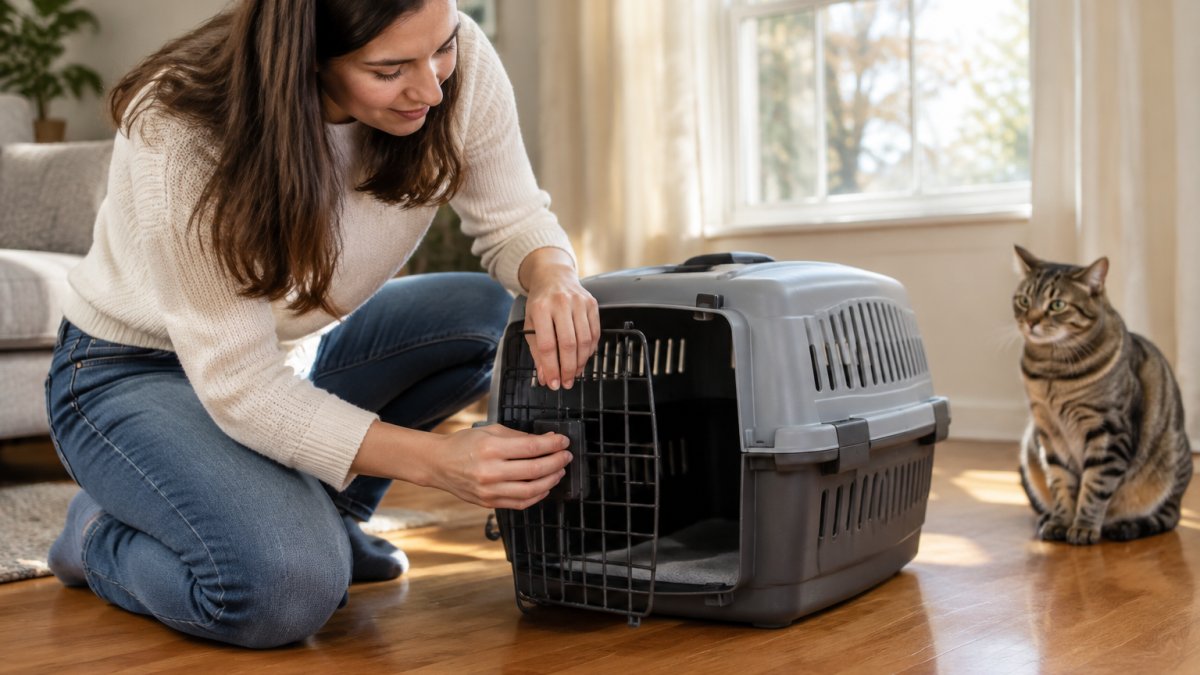
Check these before you buy:
- Latches: squeeze-style or screw-secured clips beat friction-fit tabs
- Door security: a secondary lock or self-locking zipper prevents escapes
- Ventilation: airflow on multiple sides, not just the door
- Shell integrity: top and bottom should lock together, not just sit aligned
- Interior tether: a soft-sided carrier with an internal clip adds a backup
Safe Car Restraint: What Actually Protects Your Cat
An unsecured carrier can slide or tip during a sudden stop, creating a hazard for both the cat and the people in the car.
A practical approach is to secure the carrier so it cannot slide or tip:
- Run a seatbelt through the carrier handle or around the base, and buckle it snug.
- Place the carrier flat on the floor behind a front seat when the seatbelt routing is awkward.
- Keep the carrier level and facing forward so the cat can brace against a wall rather than slide.
- Avoid stacking bags or boxes on top of the carrier during the drive.
Multi-Cat Transport: One Carrier per Cat
If you have more than one cat, transport each cat in a separate carrier. Two cats in one carrier is a common shortcut, but it removes the cat's ability to retreat and can turn a stressful ride into a fight.
For multi-cat households, matching carriers of the same model makes stacking and seatbelt routing predictable, and it keeps the handling routine identical for each cat.
If you want to know how to check build quality before you commit, our guide on how to verify pet product quality walks through what to inspect.
Best Cat Carrier for Anxious Cats
A soft-sided expandable carrier with privacy curtains, mesh ventilation, and locking zippers may suit anxious cats, since it lets you reduce visual stimulation while still giving your cat room to stretch.
The Expandable Pet Carrier Airline Approved Soft Sided Cat Dog Carrier fits that brief. It measures about 18 by 13 by 9.5 inches, has a top-expandable panel, breathable mesh on multiple sides, privacy curtains, and self-locking zippers with an internal tether. The treat-and-pet window matters more than it sounds: you can comfort your cat without opening the door.
Best for: nervous cats, waiting rooms, and owners who want a carrier that doubles as airline luggage. Skip if: your cat pushes hard against walls or your vet prefers a rigid carrier for handling.
Best Cat Carrier for Large Cats
A roomy carrier with enough interior height for standing can suit large cats, and the carrier should fit the cat you have now, not the cat you had as a kitten.
Size by Measurement, Not by Label
Weight limits are a starting point, not the answer. A carrier your cat cannot turn around in fails no matter what the scale says.
A common mistake is buying for a kitten and never sizing up. Cats fill out fast, and an undersized carrier turns every trip into a wrestling match.
The M-Pets Viaggio Pet Carrier measures 58.4 by 38.7 by 33 cm and is IATA approved, with side ventilation and a secure locking mechanism.

For a smaller option, the Ferplast Jet 10 at $40.31 is designed for small breed dogs and cats. Measure your cat first, since this carrier is sized for small breeds.

Best for: large cats and multi-cat households needing one sturdy carrier. Skip if: your cat is under ten pounds and you want something lighter to carry.
Carriers for Senior, Injured, or Mobility-Limited Cats
A carrier that opens from the top or comes apart can make it easier to lower a cat in rather than push them through a door.
If your cat is recovering from surgery or has arthritis, ask your vet which type of carrier is appropriate for the exam.
If you are settling in a new cat or caring for an older one, our essential supplies checklist covers the rest of the setup.
Carrier Training: Getting Your Cat Comfortable Before Appointment Day
Start carrier training at least a week before the appointment, and leave the carrier out in the room with the door open so your cat can get familiar with it.
Here's the sequence we recommend:
- Day 1-2: Set the carrier on the floor with a worn t-shirt or familiar blanket inside. Let your cat investigate on their own.
- Day 3-4: Feed meals beside the carrier, then inside it with the door propped open.
- Day 5-6: Add a treat toss inside, close the door for a few seconds, then open it.
- Day 7: Lift the carrier briefly, set it down, and reward. Repeat once.
- Appointment day: Load calmly, cover the carrier with a towel, and go.
The man is American.
A common mistake is only bringing the carrier out when it's time to leave. Your cat learns that carrier equals vet, and the fight starts before you reach the door. If you're settling in a new cat, our essential supplies checklist covers the rest of the setup.
Pick Your Carrier and Prep for the Next Vet Visit
Choosing a carrier is really a decision about handling, and handling is what makes or breaks the appointment. Measure your cat, prioritize a top opening and secure latches, and train in small steps over a week. Do those three things and the carrier stops being the enemy.
ShopEasyPets offers a curated selection of pet carriers, including the top-opening Skudo 2 and an expandable soft-sided carrier, so you can compare a few options in one place.
Get started with ShopEasyPets and give your cat a calmer ride to the clinic.
Frequently Asked Questions
Do vets prefer hard or soft carriers?
Most veterinary teams lean toward hard-sided carriers because the shell holds its shape and the door stays put while a technician reaches in. Soft-sided carriers work well for calm cats and short car rides, but they can sag or tip when a nervous cat pushes against the mesh. Either type is fine if the latches are secure and the cat can be lifted out safely. The bigger factor is access: a carrier that opens from the top or comes apart in halves lets staff examine your cat without tipping the whole box.
What size carrier does a large cat need?
Measure your cat from nose to the base of the tail, then add about 2 to 3 inches of extra length. For height, your cat should be able to stand and turn around without crouching. The Skudo 2 Metal Top-Opening Pet Carrier is 55 cm and has a maximum weight capacity of 18 kg (approx. 40 lbs), while the M-Pets Viaggio measures 58.4 x 38.7 x 33 cm. Weigh your cat first, then match that number to the carrier's stated capacity.
Are top-loading cat carriers easier to use at the vet?
Yes, for most vet visits. A top-loading carrier lets your vet lift the cat out from above, which is often calmer than tipping the carrier toward the door. Cats that freeze or grip the floor are easier to handle when the lid opens upward. The Skudo 2 has a metal top door plus a front opening, so you get both options in one carrier. If your cat panics in enclosed spaces, a carrier with a removable top half can be even easier, since staff can lift the top off entirely.
What is the best way to transport a cat to the vet?
Place the carrier on the floorboard or seat and secure it with a seatbelt so it cannot slide during braking. Keep the carrier covered with a light towel to reduce visual stress, and skip feeding a large meal in the hour before the drive. At the clinic, carry the carrier level and set it down rather than holding it in the air. A carrier with a secure latch system and steady ventilation, like the Moderna Roadrunner with its metal wire door and locking mechanism, keeps your cat contained through the whole trip.
